Garage door insulation problems waste energy, reduce comfort, and allow extreme temperatures to affect everything stored in your garage. Identifying garage door insulation issues early prevents rising utility bills and protects your vehicles, tools, and belongings from heat and cold damage. Understanding insulated garage door benefits helps you decide whether upgrading your door is worth the investment. Furthermore, recognizing garage door insulation advantages motivates homeowners to address failing insulation before another season passes. Knowing garage door insulation types helps you choose the right material for your climate and budget. In addition, comparing garage door insulation materials reveals significant differences in performance, durability, and cost. The garage door insulation R-value measures how effectively the material resists heat transfer through the door.
Likewise, understanding insulated garage door benefits and your garage door insulation rating helps you select the right level of protection for your region. If your garage feels like an oven in summer or a freezer in winter, search for garage door insulation problems near you to get a professional assessment.
Why Garage Door Insulation Matters
Your garage door is the largest moving object in your home and often the largest opening in your building envelope; there areinsulated garage door benefits. Specifically, an uninsulated or poorly insulated door allows massive heat transfer between your garage and the outside.
Here is why garage door insulation matters:
- The garage door accounts for up to 30 percent of your garage’s total wall area
- Uninsulated steel doors conduct heat and cold directly into the garage space
- Attached garages share walls with conditioned living space allowing temperature transfer
- Insulation reduces noise from outside traffic, storms, and neighborhood activity
- Properly insulated doors maintain more stable interior temperatures year-round
- Insulation strengthens the door panels by adding rigidity and impact resistance
Because your garage connects directly to your home’s living space in most designs, garage door insulation problems affect your entire home’s energy efficiency. Therefore, addressing insulation issues reduces heating and cooling costs throughout the house.
Signs of Garage Door Insulation Problems
Garage door insulation issues develop from age, damage, moisture, and improper installation. Furthermore, these signs tell you the insulation is failing or missing entirely as there are insulated garage door benefits.
Here are the most common signs of garage door insulation problems:
- The garage temperature closely matches the extreme outdoor temperature in summer and winter
- Also, the wall between the garage and your living space feels warm in summer or cold in winter
- Furthermore, energy bills increase without changes in thermostat settings or usage
- Condensation forms on the inside of the garage door during cold weather
- Additionally, you can feel drafts or temperature differences when standing near the closed door
- The door panels feel hot to the touch on the exterior side during summer afternoons
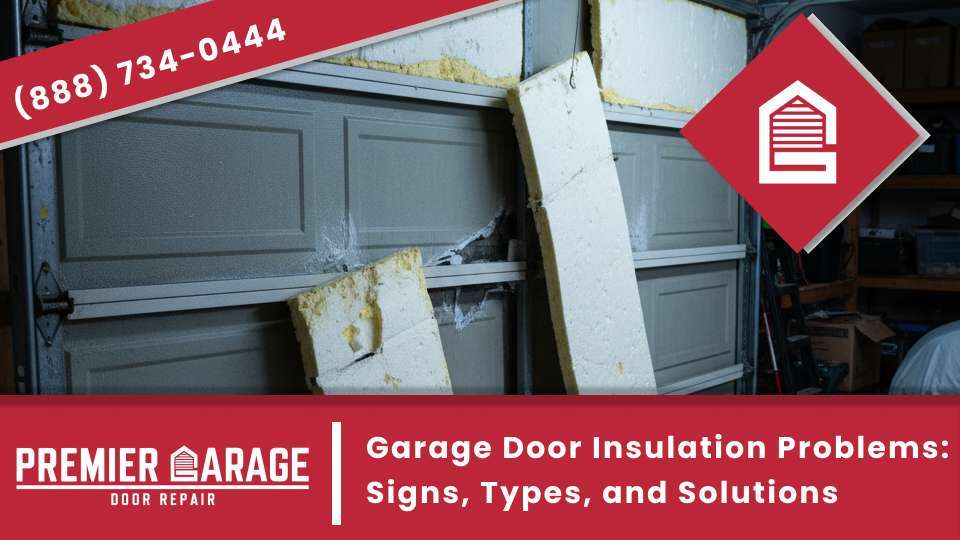
- Visible gaps, sagging, or deterioration in the insulation material between panels
- Finally, noise from outside is louder than expected when the door is closed
Condensation on the inside of the door is a particularly telling sign of garage door insulation issues. Consequently, moisture forming on the steel surface means warm garage air is meeting a cold uninsulated door which creates ideal conditions for rust and mold.
Garage Door Insulation Types Explained
Understanding garage door insulation types helps you choose the best material for your needs. Furthermore, each garage door insulation material offers different thermal performance, durability, and cost but provides insulated garage door benefits.
Polystyrene (EPS foam board) Polystyrene panels are rigid foam boards cut to fit inside door panel frames. Furthermore, they provide R-values between R-4 and R-8 depending on thickness. In addition, polystyrene is lightweight, affordable, and easy to install as a retrofit. However, it does not fill every gap inside the panel which reduces overall performance.
Polyurethane foam (injected) Polyurethane foam is injected between the steel skins of the door panel and expands to fill every cavity. Consequently, it provides the highest R-values of any garage door insulation material ranging from R-12 to R-18. Furthermore, polyurethane bonds to both steel skins creating a stronger more rigid panel. In addition, this is the preferred insulation for premium garage doors.
Reflective foil insulation Reflective foil creates a radiant barrier that reflects heat rather than absorbing it. Furthermore, it works well in hot climates where solar heat gain through the door is the primary concern. However, foil insulation provides minimal R-value on its own and works best as a supplement to foam insulation.
Fiberglass batt insulation Fiberglass batts can be installed inside panel cavities on some door designs. However, fiberglass absorbs moisture, compresses over time, and provides lower R-values than foam options. Furthermore, most garage door professionals do not recommend fiberglass for garage door applications.
Comparing these garage door insulation types reveals that polyurethane foam delivers the best overall performance while polystyrene offers the best value for retrofit applications.
Understanding Garage R-Value
The garage door insulation R-value tells you how well the insulation resists heat flow. Furthermore, understanding your garage door insulation rating helps you choose the right protection level.
Here is what R-values mean for garage doors:
- R-0 to R-4 indicates minimal insulation suitable only for mild climates
- R-6 to R-8 provides moderate insulation adequate for most temperate regions
- R-12 to R-18 delivers high insulation ideal for extreme hot or cold climates
- Higher R-values always provide better temperature control and energy savings
- The R-value applies to the insulation material itself not the entire door assembly
A higher garage door insulation R-value costs more upfront but reduces energy costs over the life of the door. Furthermore, homes in climates with extreme summer heat or winter cold benefit most from R-12 and above. In addition, attached garages with living space above or beside them need higher R-values than detached garages.
Common Causes of Problems
Several factors cause garage door insulation issues to develop over time. Specifically, understanding these causes helps you prevent problems and maintain performance.
Age and compression Insulation materials lose effectiveness over time as they compress, settle, or break down. Furthermore, polystyrene boards develop gaps as the adhesive weakens and panels shift. In addition, older doors may have insulation that has degraded to a fraction of its original R-value.
Moisture damage Water intrusion from leaking seals, condensation, or flooding saturates insulation and destroys its thermal properties. Consequently, wet insulation conducts heat rather than resisting it. Furthermore, trapped moisture promotes mold growth and accelerates rust on steel panels.
Physical damage Impact from vehicles, tools, or sports equipment crushes insulation inside the affected panel. As a result, the damaged section provides no thermal protection. Furthermore, crushed insulation cannot be restored and requires panel replacement.
Improper installation Retrofit insulation that does not fit tightly inside panel cavities leaves air gaps that reduce performance. Furthermore, insulation installed without proper adhesive shifts and falls out of position over time.
When to Call a Professional for Garage Door Insulation Problems Near You
Some insulation problems require professional evaluation and repair. Therefore, contact a technician for garage door insulation problems near you if any of the following apply:
- Your garage temperature is consistently extreme despite having an insulated door
- Condensation forms regularly on the inside of the door during cold months
- Insulation is visibly damaged, sagging, or falling out of the panels
- You want to upgrade from an uninsulated door to an insulated model
- You need help selecting the right insulation type and R-value for your climate
- Energy bills are increasing and you suspect the garage door is the cause
A garage door insulation problems expert near you evaluates your current door, measures thermal performance, and recommends the most cost-effective upgrade path. Specifically, they determine whether retrofitting insulation into your existing door or replacing it with a factory-insulated model provides better value. In addition, they ensure weatherstripping and seals complement the insulation for maximum energy savings.
Do not let a poorly insulated door waste energy and make your garage uncomfortable. Instead, call today to schedule your insulation assessment and start saving on energy costs.
Phone: (888) 734-0444
Email: info@premiergaragerepair.net
Website: https://www.premiergaragerepair.net/